
It is not uncommon for someone accused of an offence under The Public Order Act 1986 to be confused. This is unsurprising because these offences first appeared they baffled lawyers too. We were used to the need of a named victim for a crime to have taken place, but The Public Order Act meant this was no longer always the case. Not only this, but because of Public Order offences we now had to explain to suspects concepts such as a “hypothetical person” being present at the scene! At SMART Criminal Defence we understand the importance of listening to each client’s instructions and helping them understand the law and how it applies to their situation. If you are accused of any Public Order Offence, please feel free to contact us to discuss your case.
Each Public Order offences is unique, but there are some common threads which unite them. For example, Public Order offences usually involve the threat or use of violence, abuse or harassment of an individual or group. Below we run through each of the Public Order offences, beginning with the most serious and ending with the least. Please bear in mind each offence is too complicated for us to draw out every single detail on this webpage, so feel free to use each section as a way of getting just a general idea of the offence, but to get a definitive answer on whether the prosecution can prove any of the Public Offences against you, we would warmly welcome hearing from you.
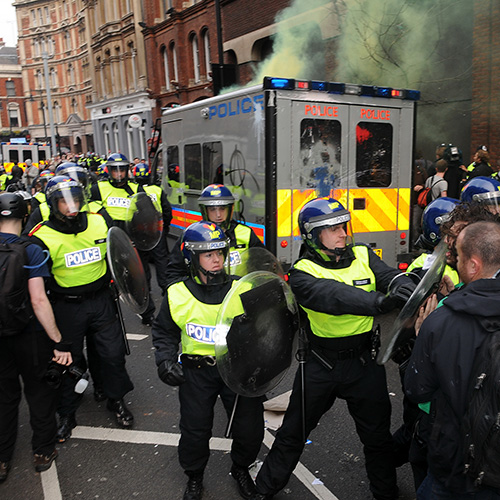
Section 1 of the Public Order Act is Riot. A riot occurs when 12 or more people, acting with a “common purpose” use or threaten unlawful violence which would cause a person of reasonable firmness present at the scene (bear in mind, this person can be that hypothetical person), to fear for their safety. To determine how the hypothetical person present at the scene might feel, the court will consider the conduct of all participants taken together. Also, the violence need not be directed towards others, it may be directed towards property.
It is easy to picture an angry uprising in a prison becoming a riot as well as hoards of looters in the streets vandalising cars and breaking into shops as they go. These examples demonstrate another key point: this offence can take place inside a property or outside.
Section 2 of the Public Order Act relates to Violent Disorder. This offence is virtually identical to a riot however, it need only involve 3 or more people. It is worth noting that the participants need only be “present together”, the prosecution need not prove that there was any degree of co-operation.
A typical example of violent disorder may occur when rival groups start a fight using weapons in the town centre or a crowded bar. Another might be at a football match when opposing fans come up against each and start throwing beer bottles towards each other.
Section 3 of the Public Order Act is commonly known as an Affray. This occurs when a person uses or threatens unlawful violence, again, such that the hypothetical person present at the scene would fear for their safety. The threat cannot be by words alone, so the key is looking at the physical behaviour of the person accused (although words spoken, or shouted, will no doubt have a bearing on the conclusions any court comes to!).
This Public Order offence is typically charged when two or three people get involved in a fight in the street which is caught on CCTV, but no party wishes to give a statement against the other. If each of the parties are correctly identified, the court could quite properly convict based simply on the CCTV footage.
Section 4 of the Public Order Act is the fear or provocation of violence. It involves the use of threatening, abusive or insulting words and behaviour. This offence is best demonstrated by examples:
- Threats made towards innocent bystanders or individuals carrying out public service duties
- The throwing of missiles by a person taking part in a demonstration or other public gathering where no injury is caused
The unlawful violence feared/likely to be provoked, etc. must be “immediate” i.e. be happening there and then. So, an example often used to demonstrate when an allegation is too remote for a section 4 Public Order Act to be proved is if an author seeks to provoke violence through what they write in a book.
Section 4A of the Public Order Act involves the intentional harassment, alarm or distress. Although these words appear to speak from themselves, it must be remembered that it is not enough that the accused intended to harass, alarm or distress, what is key is that the prosecution can prove that someone actually suffered harassment, alarm or distress. However, the evidence of this need not come from that person themselves but, say, from another witness who can say that the victim showed signs of harassment, alarm or distress.
A very simple example of a typical section 4A Public Order offence is insulting another person by shouting abuse at them.
Section 5 of the Public Order Act involves the harassment, alarm or distress of another. The behaviour involved does not require any element of violence (actual or threatened); and it includes conduct that is not necessarily threatening or abusive. Section 5 Public Order offences are usually charged for less serious incidents of anti-social behaviour such as:
- Someone causing a continuous disturbance in a residential area
- A drunk reveller meandering home, swearing at anyone who looks at him
- Someone approaching and pestering a queue of people waiting at a bus stop
We hope that this page shows that Public Order offences can be quite complicated! However, rest assured that we would happily talk you through this minefield. Please feel free to use our contact page or call us free of charge on 0333 200 8581. We pride ourselves in getting back to all enquirers promptly.